
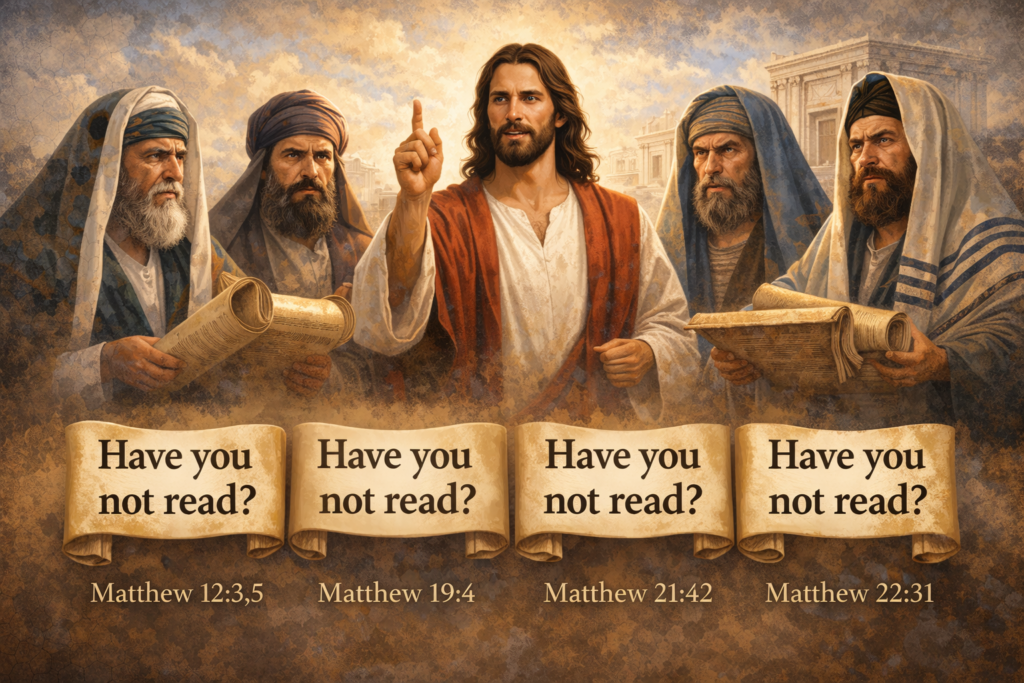
In this article, we will study four occasions when Jesus said, “Have you not read” in His discussions with the Jewish religious leaders.
These people were devoted students of Scripture. Many of them had memorized large portions of God’s word. So when Jesus says, “Have you not read?” to them, he’s not saying they needed to go back and read their Bible because they had forgotten to read Numbers. He’s drawing attention to the fact that while they had read the Scriptures, they had not properly understood them.
Now, while we should certainly read all of God’s word, this question focuses on whether or not we understand what we are reading. Each of the passages we will notice in Matthew highlights something that is required for us to properly understand God’s word.
A Proper Understanding of Scripture Requires Mercy (Matthew 12:3, 5)
When the Pharisees approached Jesus about the actions of His disciples on the Sabbath, they did so with a desire to condemn (v. 1-2). Jesus asked them, “Have you not read” twice, and pointed them to two groups that God was merciful to (v. 3-6).
They had overlooked the significance of passages like Hosea 6:6, which emphasized God’s willingness to extend mercy and His desire for His people to show mercy. Also, in being quick to condemn, they had actually “condemned the guiltless” (v. 7).
Properly understanding Scripture requires us to realize how important mercy is to God, which means it should be important to us. Those who are quick to condemn others – especially if that condemnation is based on traditions or opinions – have missed the point of Scripture.
A Proper Understanding of Scripture Requires Reasonableness (Matthew 19:4)
The Pharisees approached Jesus to test Him, and asked if it was “lawful [according to the Law of Moses] for a man to divorce his wife for just any reason?” (v. 1-3). Jesus responded by asking, “Have you not read?” and then pointed them back to God’s initial design of marriage at the beginning, and said man should not separate what God has joined together (v. 4-6; Genesis 1:27; 2:24).
The Jewish leaders challenge the Lord by asking, “Well, what about what Moses did?” (v. 7). Jesus responds, “Moses permitted you to divorce your wives because you were as stubborn as mules and were dead set on doing what you wanted to do!” (v. 8). Their “hardness of heart” is similar to the word “obstinate,” which means, “to be stubbornly determined to do what you want and refuse to change your mind, behavior, or opinion, even when faced with reason, arguments, or persuasion.” (Dictionary)
Jesus identifies their improper understanding of the matter of divorce as having a direct connection to their stubbornness and unreasonableness. If we are not willing to humble ourselves and honestly reason about the Scriptures (Isaiah 1:18), we will never reach a proper understanding of them.
A Proper Understanding of Scripture Requires Selflessness (Matthew 21:42)
Jesus told a parable of a landowner who rented out his vineyard to tenant farmers. But when he tried to send his servants to collect his portion, the tenant farmers violently rejected everyone he sent. Finally, the landowner sent his son, whom the tenant farmers killed, thinking the landowner would be forced to turn the land over to them since there was no other heir. But of course, the landowner would not do this (v. 33-41).
Jesus then quoted Psalm 118:22-23 to show that this was exactly what the Jewish leaders were doing in rejecting Him (v.42-45). If they thought they could oppose the Son of God and “take by force” what belonged to God, they were just as foolish as the tenant farmers in the parable.
I think Jesus is pointing out that their selfish desires had blinded their understanding of God’s word. They were more interested in receiving the praise of men than the praise of God (John 12:42-43). To properly understand God’s word, we must be willing to set aside our own selfish desires and submit to God (Matthew 16:24).
A Proper Understanding of Scripture Requires Carefulness (Matthew 22:31)
When the Sadducees challenged Jesus on the resurrection, He first addressed their ignorance of the Scriptures (v. 23-30). Then, He made an argument for the resurrection based on the tense of one word from Exodus 3:6 – “I am” (present tense).
Abraham, Isaac, and Jacob had already died and been buried a long time before God spoke those words to Moses. But God said, “I am currently the God of Abraham, Isaac, and Jacob,” which implies they were still living (v. 31-32).
Properly understanding God’s word requires careful exactness in our handling of Scripture (2 Timothy 2:15).
Conclusion
Each of these four times when Jesus asked, “Have you not read?” showed the Jewish leaders’ lack of understanding when it came to the Scriptures. The way we approach God’s word plays an enormous role in whether or not we will understand it.