Have you ever had someone who just really did you wrong? Maybe it was someone at school, or a family member, or a co-worker, or a friend. We could all probably recall at least one situation in our lives when something like that happened to us.
How did what they did to you make you want to respond? Maybe we were ready to fight, maybe we wanted to tell all the “dirt” we knew about them. Probably, we wanted them to know how it felt to be treated the way they’d treated us.
What does Jesus have to say about people like this?
Jesus’ Words (Matthew 5:43-48)
In what Jesus says here, our “neighbor” would be people close to us who are friendly to us, and our enemies would be those who hate us and are hateful to us. Jesus says we are to “love” those who hate us, “speak well” of those who say hateful things about us, “do good” to those who do hateful things to us, and pray to God on behalf of those who spread things about us that aren’t true. In other words, we are trying to build them up while they are trying to tear us down.
Why should we do this? Because this is what our Father in heaven does. He doesn’t merely bless those who love Him, but He also provides many abundant blessings to those who hate Him.
As God’s people, aren’t we supposed to be different than this world? But if we treat the world the same way they treat us, then how are we any different? So, we are called to be like our Father in heaven.
David’s Example (1 Samuel 24, 25, 26)
1 Samuel 24
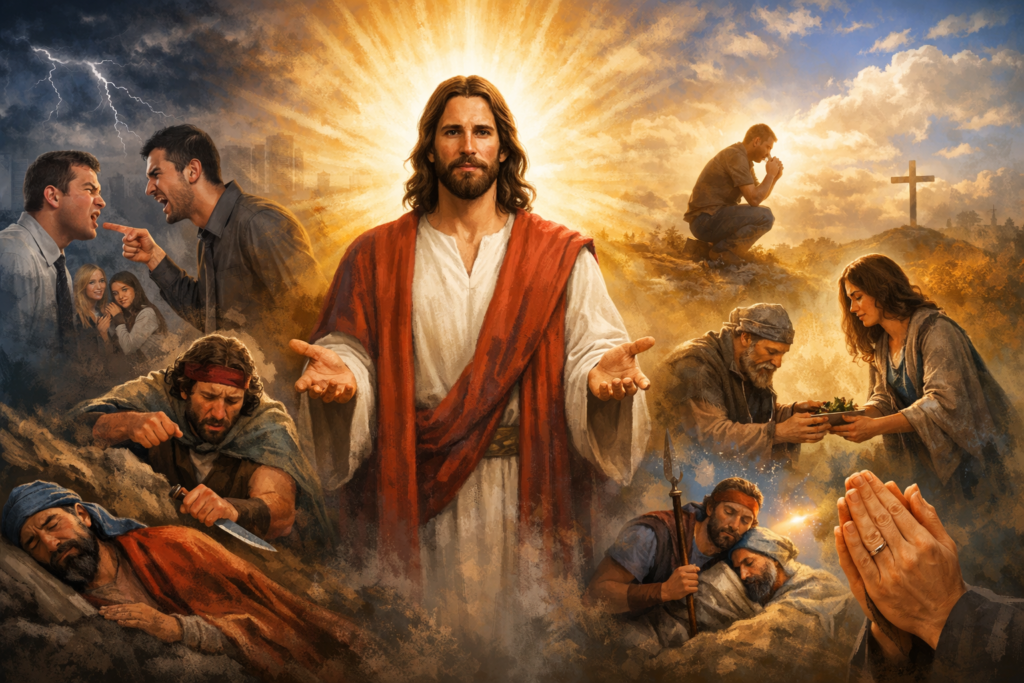
Saul chased David with 3,000 of his best soldiers, intending to kill David. Sometime during the manhunt, they discovered a cave, and Saul went inside to use the bathroom. As it turned out, David and his men were hiding in this same cave (v. 1-3).
David’s men urged him to take Saul’s life, reminding him that the LORD said he would deliver Saul into his hand. But David only snuck up and cut off a corner of Saul’s robe. Afterward, David’s conscience bothered him greatly that he had even done this, and he told his men that he could not lift his hand against God’s chosen king (v. 4-6). When Saul learned how David had shown him mercy, he wept and went home.
1 Samuel 25
While David and his men were staying in the wilderness, they protected the herds of a man named Nabal. David sends messengers to Nabal, telling him how he had been helping look out for his herds and shepherds, and asks for supplies. Instead of being thankful, Nabel arrogantly insults David, essentially spitting a venomous response in his face (v. 4-11).
David and his men go on the warpath, intending to completely wipe Nabal’s family out (v. 21-22). The Psalms reveal David to be a man of great passion and emotion, and this is one of the times the guardrails have been removed from containing his swelling passions.
Nabal’s wife, Abigail, quickly went out to meet David with supplies and begged him to disregard her husband’s foolishness (v. 24-25). She urges David to forgive and not retaliate, because there would come a day when David would deeply regret what he had done in anger (v. 30-31). And David, to his credit, listened to the advice of this godly woman and did not follow through on what he had planned to do (v. 32-35).
1 Samuel 26
Saul is again convinced to hunt down David to kill him, but David knew where Saul and his men had camped (v. 1-4). David and Abishai slipped into Saul’s camp at night and came to where King Saul was sleeping. Abishai asked David to allow him to kill Saul, but David refused to allow anyone to harm God’s king. He left the matter in God’s hands for God to do as He saw fit (v. 8-11).
Once they had left the camp, David called out to Saul and again asked why he was trying to kill him. Saul again admits his sin and is deeply touched by how David had once again shown him mercy. He stops chasing after David (v. 21-25). It wasn’t too long after this that King Saul died (1 Samuel 31).
God and His Enemies
In Romans 5:10, Paul refers to us as once being God’s “enemies.” Interestingly, this is the exact same word Jesus used in Matthew 5:43-48. When we were God’s enemies, what did He do?
After being slapped, beaten, and scourged to the point where He no longer looked human (Isaiah 52:14), after experiencing the agony of being nailed to the cross, and while He was being openly mocked to His face, Jesus uttered one of the most profound sentences in the history of the world: “Father, forgive them, for they do not know what they do” (Luke 23:34).
The One who had the power to stop it all – to do whatever He wished to His enemies! The One who said all it would take would be for Him to ask the Father, and the armies of heaven would pour forth (Matthew 26:53)!
What He chose was not to treat us as we treated Him. Instead, He chose to love His enemies (Romans 5:6-10). He chose to forgive us (Acts 2:37-38).
And so, when someone does us wrong, says hateful things about us, or treats us in a hateful way, how should we respond? We who once treated God hatefully and received His love in return – how should we, as His children and followers, respond?
Conclusion
As Christians, we are no longer God’s enemies, but we all used to be. And if God had been unwilling to show us His love by sending His Son to die for us, we would all still be His enemies.
If you are not a Christian, you are still in your sins, separated from God (Isaiah 59:1-2). But you don’t have to stay that way. You have behaved hatefully toward God, but God extends His love to you through His Son. Have faith in Him, turn from your sins, declare your allegiance to Him, and be baptized in His name for the forgiveness of your sins (Acts 2:38). Don’t reject the love of God.
Many of us are already Christians, but perhaps in the way we’ve treated others, we’ve shown we’ve forgotten the love of God. We are commanded to be like our Father, and love one another (1 John 3:11). If we hate one another, we will miss out on eternal life (1 John 3:15). If we refuse to be like our Father, why would we get to live with Him eternally?